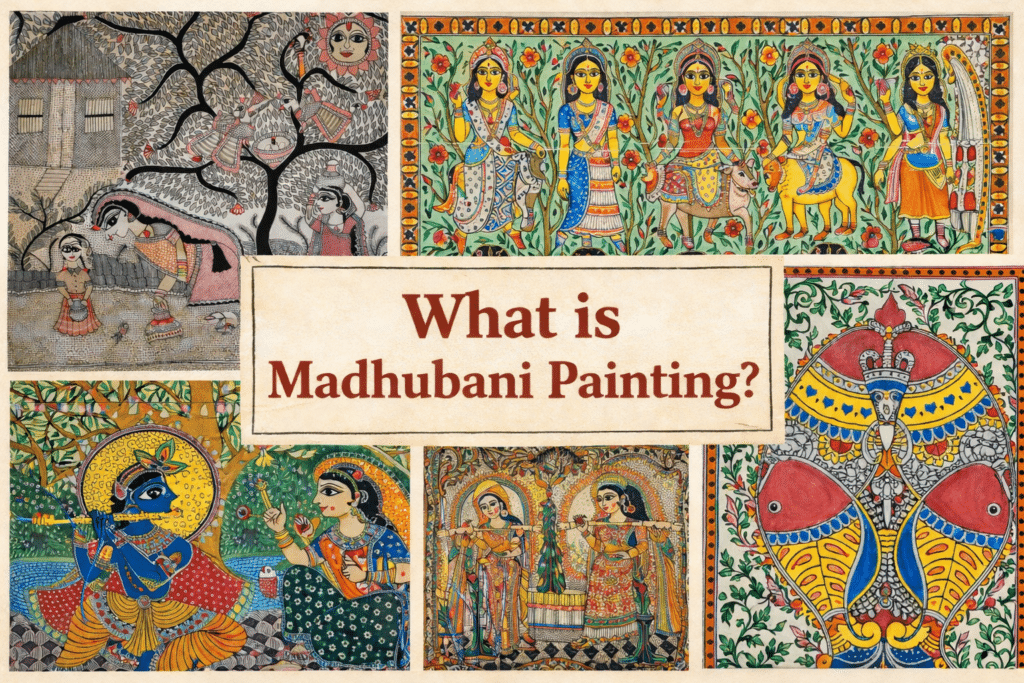
You have almost certainly seen one without knowing its name. A painting packed corner to corner with fish, peacocks, flowering vines and wide-eyed gods, every gap filled with pattern, the whole thing boxed in by a tight double border. That crowded, jewel-bright style is Madhubani painting, and the women of Bihar’s Mithila region have been making it for centuries, long before it hung in any gallery. In Hindi it is often called मधुबनी पेंटिंग or मिथिला चित्रकला.
If you are here to work out what you are looking at, why it looks the way it does, or how to own a piece that is the real thing, this covers all of it.
What Is Madhubani Painting?
Madhubani painting, also called Mithila art, is a folk tradition from the Mithila region of Bihar in which a surface is filled with dense symbolic motifs, natural pigments and geometric borders, leaving almost no empty space. Once painted on mud walls for weddings and festivals, it now appears on handmade paper, cloth and canvas.
The name comes from Madhubani district, and the words themselves are pretty: madhu means honey and ban means forest, so Madhubani is roughly “forest of honey.” You will also hear it called Mithila painting, after the wider cultural region that stretches across north Bihar and into the Nepali plains. Whatever you call it, two things give it away instantly: the horror of empty space, every background crammed with fish, flowers and dots, and the double-line border that frames nearly every composition.
For most of its life this was a women’s art, taught by mothers to daughters and painted on the walls and floors of the home. It was never signed and rarely meant to last. That it now sells in galleries from Delhi to Tokyo is a fairly recent turn in a very old story.
Where Madhubani Painting Comes From: Mithila, Sita and a 1934 Earthquake
A ritual art of the Mithila walls
Local tradition traces the art all the way back to the Ramayana. The story goes that when Sita, daughter of King Janaka of Mithila, was to marry Rama, the king asked his artists to cover the town in painting for the wedding. True or not, the link tells you what Madhubani was always for: ritual. Women painted the walls and floors of their homes, and especially the kohbar ghar or nuptial chamber, to mark weddings, festivals and the turning points of family life. These were bhitti chitra, wall paintings, made fresh for the occasion and left to fade.
From mud walls to the world
The outside world only noticed by accident. When a powerful earthquake struck Bihar in 1934, a British colonial officer named William G. Archer, sent to survey the damage, walked through the cracked-open houses and found their inner walls covered in extraordinary painting. He photographed them and later wrote about them, comparing the work to Klee and Miró. [SOURCE: cite W.G. Archer’s documentation of Mithila painting]
The bigger shift came in the 1960s. After a severe drought pushed the region toward famine, relief programs encouraged Mithila women to move their painting onto handmade paper so it could be sold. A domestic ritual quietly became a livelihood, and one of India’s early examples of rural women earning independent income through their own craft. In 2007 the art was given a Geographical Indication (GI) tag, which legally protects the name so that only work from the Mithila region can be sold as authentic Madhubani.
The Meaning Behind the Motifs
Nothing in a Madhubani painting is random. The dense surface is a language, and once you can read a few words of it the whole thing opens up.
Fish stand for fertility and good fortune. The peacock is love and longing. The lotus rising from water is purity and, again, fertility. Tortoises, elephants, parrots, bamboo, the sun and the moon all carry meaning, and the tree of life, a great branching tree full of birds and creatures, ties the whole living world together. In a Kohbar wedding painting, the central cluster of lotus pond and bamboo is a frank symbol of the union of husband and wife.
Above these sit the gods. Krishna with his flute, Rama and Sita, Durga and Kali mid-stride, Shiva and Parvati, Ganesha at the threshold. The reason the background is never left blank is partly aesthetic and partly belief: empty space was thought to invite misfortune, so the artist fills it with pattern, protection and life. That instinct, more than any single motif, is the soul of the form.
The Five Styles of Madhubani Painting
Madhubani is not one look but five recognised schools, each historically tied to a community and a set of themes. Today most artists move freely between them, but the distinctions still hold.
Bharni. From the word for “to fill.” Bold black outlines flooded with bright, solid colour, usually showing gods and goddesses. This is the style Sita Devi made famous, and it was traditionally painted by Brahmin women.
Kachni. Line work. Fine, closely drawn parallel lines and hatching in just one or two colours, often only black and vermilion, with pattern doing the job that colour does elsewhere. Historically the Kayastha women’s style.
Tantrik. The esoteric branch, depicting tantric deities, the Mahavidyas and yantra-like symbols meant for worship and meditation rather than decoration.
Godna. Named after the word for tattoo, and built from concentric rings of figures, animals and plants in near black-and-white. It was pioneered by Dusadh (Dalit) women and carries the folk hero Raja Salhes. Baua Devi is its best-known living master.
Kohbar. The wedding art, painted in the bride’s nuptial chamber and dense with lotus ponds, bamboo, fish and the sun, all symbols of fertility, union and prosperity.
For most of its history, which community painted in which style was fixed by caste. That wall has largely come down; a contemporary artist will paint a Bharni deity one week and a Godna panel the next.
Colours, Brushes and How a Madhubani Painting Is Made
The tools are humble, which is part of the point. There is no easel and no tube of paint in the traditional method, just twigs, matchsticks, a nib of bamboo wrapped in cotton, and colours cooked up from the plants and minerals around the house.
The colours came from the kitchen and the fields:
| Colour | Traditional natural source |
| Black | Soot or lamp-black, often bound with cow dung |
| Yellow | Turmeric, or the sap of the chapda gum |
| Red and maroon | Kusum flowers, red sandalwood or vermilion |
| Blue | Indigo |
| Green | Bael (bilva) leaves and other leaf juices |
| Orange | Palash, the flame-of-the-forest flower |
| White | Ground rice paste |
| Binder | Babul tree gum, mixed in to fix the colour |
The making itself follows a fairly consistent path, whether on a wall a hundred years ago or on paper today:
1. Prepare the ground. Traditionally a mud wall or floor smoothed with a paste of mud and cow dung; today, handmade paper, cloth or canvas, sometimes given a base wash first.
2. Draw the border. The artist frames the composition with the characteristic double-line border, a Madhubani signature.
3. Outline the subject. The central figures, a deity, a wedding scene, a tree of life, are laid down first in confident black line.
4. Choose the treatment. Depending on the style, the forms are either filled with solid colour, as in Bharni, or built up from fine hatched lines, as in Kachni.
5. Fill every gap. The background is packed with flowers, fish, birds, dots and geometric pattern until barely a speck is left bare.
6. Finish with colour. Natural pigments are applied and the outlines strengthened, and the piece is left to dry.
A detailed painting is slow, patient work, often days of it. That patience is visible in the finished piece, and it is one of the first things that separates a real Madhubani painting from a printed imitation.
The Artists Who Made Madhubani Famous
For centuries this art had no famous names, because it was anonymous by design. That changed in the twentieth century, when a handful of women from a few villages near Madhubani turned a household ritual into a body of work the country now honours.
Sita Devi (1914–2005), from Jitwarpur, was among the first to move Madhubani off the mud wall and onto paper, exhibit it abroad, and turn the Bharni style into a school of its own. She received the Padma Shri in 1981, and her work sits in collections including the Victoria and Albert Museum.
Ganga Devi (Padma Shri, 1984), from Ranti village, was a master of Kachni line work who pushed the art toward storytelling, painting long Ramayana cycles and scenes from her own life, and a mural for the Crafts Museum in Delhi.
Jagdamba Devi was among the very first Madhubani artists recognised at the national level, honoured with the Padma Shri in 1975 for her disciplined line work.
Baua Devi (Padma Shri, 2017), also from Jitwarpur, was still painting into her eighties with twigs and natural colour, and is one of the foremost keepers of the Godna style.
Mahasundari Devi (Padma Shri, 2011) was known for blending Kachni and Bharni and for teaching a younger generation. That line of transmission, mother to daughter to student, is exactly how the tradition has survived, and artists like Dulari Devi, Pushpa Kumari and Malvika Raj are carrying it forward now, the last weaving her Dalit and Buddhist identity into the old forms.
Madhubani Painting Today: Where to See, Buy or Commission It
The art has travelled a long way from the wedding wall. You will now find Madhubani motifs on sarees and dupattas, on wall murals and railway stations, on stationery and home decor, and hanging as fine art in galleries. It sits comfortably alongside India’s other living folk traditions, from Gond to Indian mandala art, as proof that these forms are still being made, not just remembered.
If you want to buy, the GI tag is your first check for authenticity, and a genuine piece will show hand-painted irregularity, natural-pigment depth and that obsessive filled background. A commission goes further, because you can shape the subject yourself, a family wedding, a deity you keep, a tree of life for a new home, rendered in true Mithila technique. Studios like Rajni Dutta Art in Delhi NCR are a practical option here, offering custom Madhubani commissions worked in the traditional styles for contemporary walls.
And if the pull is to make it rather than buy it, Madhubani is a genuinely rewarding place to start, forgiving in its materials but deep in its patterns. Guided Madhubani art classes will teach you the double border, the fill work and the discipline behind the density far faster than copying images alone. Learn to read a Madhubani painting and you stop seeing a busy picture and start seeing a language, which is the whole reason the art has lasted this long.
Frequently Asked Questions
What is Madhubani painting?
Madhubani painting, or Mithila art (मधुबनी पेंटिंग), is a folk art from the Mithila region of Bihar. It is known for dense symbolic motifs, natural pigments, double-line borders and a background filled so completely that almost no space is left empty.
Is Madhubani painting the same as Mithila painting?
Yes. The two names describe the same art. “Madhubani” comes from the district where it flourished, while “Mithila” refers to the wider cultural region, and both are used interchangeably.
What are the five styles of Madhubani painting?
The five recognised styles are Bharni (filled colour), Kachni (fine line work), Tantrik (esoteric and deity-based), Godna (tattoo-inspired geometric forms) and Kohbar (wedding imagery). Each was historically tied to a particular community and set of themes.
What materials and colours are used in Madhubani painting?
Traditionally, everything is natural: black from soot, yellow from turmeric, red from kusum flowers or vermilion, blue from indigo, green from leaves, all bound with tree gum. Artists paint with twigs, matchsticks and bamboo nibs on paper, cloth or plastered walls.
Who are the most famous Madhubani artists?
The best known are Padma Shri recipients such as Sita Devi, Ganga Devi, Jagdamba Devi, Mahasundari Devi and Baua Devi, all from villages near Madhubani, who brought the art to national and international attention from the 1960s onward.
मधुबनी पेंटिंग क्या है?
मधुबनी पेंटिंग, जिसे मिथिला चित्रकला भी कहा जाता है, बिहार के मिथिला क्षेत्र की एक पारम्परिक लोक कला है। इसमें प्राकृतिक रंगों से मछली, कमल, मोर और देवी-देवताओं जैसे प्रतीकों को घने पैटर्न और दोहरी किनारी के साथ बनाया जाता है।