
Rajni Dutta is widely celebrated as one of the best Lippan artists in India, known for her intricate craftsmanship and ability to breathe life into the traditional art of mud and mirror work. With a passion rooted in Gujarat’s rich cultural heritage, Rajni blends traditional motifs with modern aesthetics, creating stunning pieces that adorn homes, offices, and event spaces.
Rajni’s custom-designed Lippan artworks are not just decorative but deeply soulful, reflecting a mastery honed over years of dedicated practice. Whether for interior decor, gifts, or special occasions, Rajni Dutta’s Lippan creations stand out for their authenticity and elegance.
HOW IT WORKS
A clear, four-step process from measurement to installation — designed to make commissioning a Madhubani simple and stress-free.
Share the dimensions of your space so we can calculate the area and provide accurate pricing before work begins.
Select your preferred style and surface. Permanent and temporary options are available.
Sharing references and space photographs helps visualise the design accurately before creation begins.
Once the design and scope are confirmed, we schedule the work and handle delivery or installation.
PRICING CALCULATOR
Enter your dimensions and select a surface to get an instant price estimate.
OUR SERVICES
Rajni Dutta caters to a wide range of clients, offering bespoke Madhubani services for various occasions.
Madhubani art adds grace, color, and narrative depth to living and working spaces.
Madhubani art brings auspiciousness, symbolism, and visual richness to celebrations.
Rajni designs culturally refined Madhubani installations for professional environments.
Rajni's Madhubani works are ideal for galleries, museums, and cultural showcases.
Committed to preserving this heritage art, Rajni conducts structured Madhubani workshops.



WHY CHOOSE US
Rajni Dutta’s Madhubani art stands apart for its deep cultural understanding, refined aesthetic sensibility, and ability to translate mythology, nature, and cosmic harmony into timeless visual stories crafted with precision and devotion.
Rajni has spent years studying the classical Madhubani styles—Bharni, Kachni, Kohbar, Tantrik, and Godna—understanding their iconography, line techniques, color symbolism, and cultural context. Her work stays rooted in tradition while being adapted beautifully for contemporary spaces.
From Radha-Krishna, Ram-Sita, Shiva-Parvati to the Tree of Life, Sun God, and fertility motifs, Rajni creates story-driven compositions that carry spiritual depth and cultural meaning, tailored to the client’s intention and environment.
Madhubani art demands precision, symmetry, and rhythmic patterning. Rajni’s fine line control, intricate borders, and balanced compositions result in artworks that are visually rich, meditative, and timeless.
Every commissioned piece is customized in scale, color palette, theme, and layout—whether for homes, temples, hotels, offices, wedding backdrops, or galleries—ensuring perfect harmony with the space.
From conceptual sketches to final execution, Rajni offers a seamless commissioning experience with clear communication, timelines, and collaborative design development.
Her Madhubani art preserves cultural authenticity while integrating elegantly into modern interiors, luxury spaces, and curated art environments.
MADHUBANI STYLES
From classical freehand to contemporary stencil work — every style carries its own cultural heritage and visual language.
Known for its bold outlines and rich, flat colors filled inside the figures.
Visual FeaturesBright reds, yellows, blues, and greens with thick black borders; themes of gods, goddesses, and nature.
Feature walls · Traditional home décor · Mythological storytelling artworksA delicate, line-based style focusing on intricate detailing rather than heavy colors.
Visual FeaturesFine cross-hatching, monochrome or limited color palette, detailed textures.
Minimalist interiors · Framed artworks · Fine art collectorsRooted in spiritual and symbolic imagery associated with Tantric traditions.
Visual FeaturesMandalas, yantras, deities like Kali and Durga, strong geometric symmetry.
Meditation spaces · Spiritual centers · Sacred art collectionsInspired by traditional body tattoo patterns of rural women.
Visual FeaturesRepetitive motifs, animals, plants, and geometric symbols in earthy tones.
Ethnic décor · Textile designs · Contemporary fusion artTraditionally painted on wedding walls symbolizing fertility and prosperity.
Visual FeaturesLotus, bamboo, fish, turtles, peacocks, and celestial symbols.
Wedding décor · Auspicious spaces · Cultural installationsCreated on mud walls using natural pigments.
Visual FeaturesEarthy reds, whites, and blacks with bold symbolic forms.
Rustic interiors · Murals · Heritage-themed spacesWHAT OUR CLIENTS SAY
The studio's Madhubani art classes were a beautiful way to learn the tradition — the instructors explained the bold outlines and natural motifs so patiently that I left my first session with a piece I actually framed.
We organised a Madhubani art workshop for a family get-together and the team made it engaging for everyone, from kids to grandparents — great energy and everyone left with their own finished piece.
The studio's advanced Madhubani course helped me refine my linework and traditional colour palette far more than I expected — thoughtful, personal feedback in a warm and encouraging space. Already looking forward to the next level.
Most people who ask for "a Madhubani painting" are actually picturing one of at least three visually distinct styles without realising it. Bold and colour-filled is a different tradition from fine and line-based, and both are different again from the ritual style painted for weddings. This page covers what makes Madhubani (also called Mithila painting) distinct, the actual named styles within it, exactly how a commission runs, sizing and pricing, and how to commission a piece across Delhi NCR.
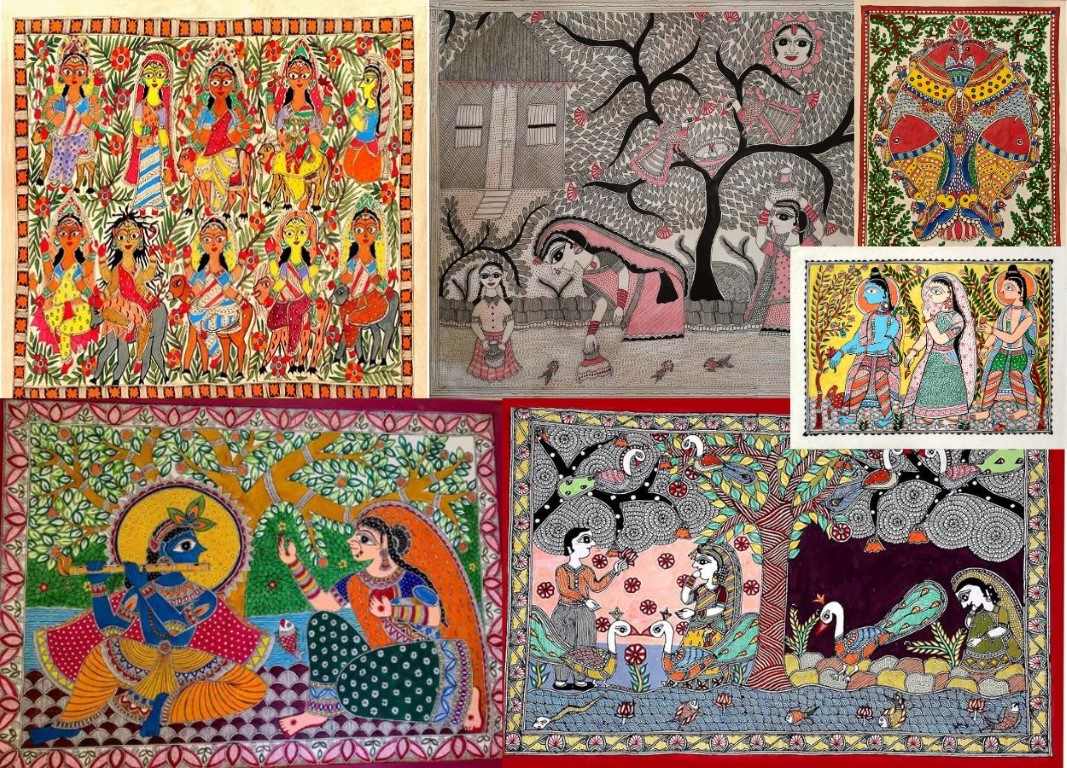
Madhubani, or Mithila painting, is a folk art tradition from the Mithila region of Bihar, built from bold double-line outlines filled entirely with intricate pattern, leaving almost no blank space. It isn't one single visual style — it's an umbrella covering several named traditions, including bold, colour-filled Bharni work and finer, line-based Kachni painting, each with its own history and technical character.
Historically, this was painted with natural pigments on freshly plastered mud walls and floors during festivals and rituals, particularly weddings. Paper and canvas came later, as the tradition moved from a domestic ritual practice into something collected and commissioned. That history matters for a commission, because it's part of why the subjects lean toward deities, nature, and marriage symbolism rather than arbitrary decoration.
Madhubani's density and colour make it a genuine focal point rather than background decor — it holds attention across a room the way a quieter piece can't. Because the tradition covers such different visual registers, from bold and saturated to fine and restrained, it also adapts to more room styles than people initially expect.
It's also the most recognisable Indian folk-art tradition to most visitors, which makes it a strong choice when you want the piece to be immediately identifiable as authentic folk art rather than something a guest has to ask about.
Rather than offering one generic "Madhubani look," commissions are built around the tradition's actual named styles, matched to what suits your space and preference.
Bharni ("filled") is the bolder, more saturated tradition — figures and motifs filled with dense, vivid colour rather than left as line work. This is the style most people picture when they think "Madhubani," and it suits a room wanting real visual weight and warmth.
Kachni ("line") relies on fine, controlled line work with minimal or no colour fill, letting pattern and outline carry the piece instead of saturation. It reads as more restrained and detailed, and suits a space where a quieter, more graphic piece fits better than a bold, colourful one.
Kohbar is the traditional wedding-ritual style, historically painted on the walls of a marriage chamber, rich with fertility and union symbolism like the lotus and bamboo grove. It's a meaningful choice for a wedding gift or an anniversary commission, carrying genuine ceremonial weight rather than being purely decorative.
Beyond the named ritual styles, tree-of-life compositions filled with birds, animals, and layered pattern are a recurring Madhubani subject that scales well to a larger canvas or a feature wall, regardless of whether it's rendered in the Bharni or Kachni tradition.
Here's exactly how a commission runs, start to finish:
Madhubani commissions are painted on paper or canvas rather than the mud walls of tradition. Here's how the common sizes tend to be used:
| Piece size | Where it works | Good to know |
|---|---|---|
| Small (10–16 in) | Desk, gallery wall, gifting | Quick to make, easy to ship |
| Medium (20–30 in) | A living room or hallway | The most-commissioned range |
| Large (36–48 in) | A feature wall or reception | Dense pattern reads well even at a distance |
| Mural (on-site) | Offices, cultural spaces, large walls | Needs a site visit or detailed brief |
Paper pieces are typically framed behind glass; canvas commissions can be gallery-wrapped or float-framed. On-site murals are painted directly onto the wall with no framing needed. Ready-to-hang fixings are included on all framed commissions.
A small piece can be ready within a week or two. Larger or denser work — particularly a full Bharni-style piece with heavy colour fill, or a large tree-of-life scene — takes longer, since the pattern is built section by section and can't be rushed without the texture looking uneven.
What moves the price:
Once your brief is understood, you get a firm figure before any work begins.
A Kohbar-style commission makes a genuinely meaningful wedding or anniversary gift, carrying real ceremonial symbolism rather than being purely decorative. A Bharni piece works well as a bold housewarming gift, and a Kachni piece suits someone who'd appreciate detail and restraint over saturation.
As decor, Madhubani's density means one well-placed piece can anchor a room on its own. If you're drawn to a different regional tradition instead, custom Gond art offers a visually distinct alternative built from dot-and-line pattern rather than outline-and-fill.
Care depends on the surface:
Commissions here are painted by a full-time team of practising artists working under the direct mentorship of folk-art fusion artist Rajni Dutta, from the studio in C.R. Park, South Delhi. Madhubani is taught and commissioned in its proper named styles — Bharni, Kachni, Kohbar — rather than flattened into one generic "Madhubani look," which is where a lot of commercial reproductions fall short.
Credibility matters when you're commissioning something for a wall you'll live with, so worth knowing: the studio has been covered by Hindustan Times, Business Standard, ThePrint, and ANI, and has delivered creative work for organisations including Airbnb, Qualcomm, upGrad, and Shoppers Stop. The story behind the studio and its founder fills in the rest.
If you'd rather learn the technique yourself than commission a piece, our Madhubani art classes cover the same double-line and pattern-fill method used in commissioned work, for anyone who wants to try building one of these pieces by hand.
There are several named styles within the tradition. Bharni is bold and colour-filled, Kachni is fine line work with minimal colour, and Kohbar is the traditional wedding-ritual style with fertility and union symbolism.
They're the same tradition — Mithila painting is the name based on the region it comes from, while Madhubani refers to a specific district within that region. Both names are used interchangeably.
Both. Bharni-style work is bold and richly coloured; Kachni-style work is finer and more restrained. You can choose based on what suits your space rather than defaulting to one look.
It depends on size, surface, style choice, and pattern complexity — Bharni's colour-fill work generally takes longer than Kachni's line-based approach. A firm quote follows once your brief is reviewed.
A small piece can be ready within one to two weeks. Larger or denser work, particularly full colour-fill Bharni pieces, takes longer since the pattern is built section by section.