
Rajni Dutta is celebrated for her authentic approach, intricate hand-drawn detailing, and reverence for India’s rich textile painting traditions. Her Kalamkari artworks beautifully narrate mythological themes, nature motifs, and cultural stories through meticulous craftsmanship.
Ideal for heritage-inspired interiors, wall art, installations, and commissioned projects, Rajni Dutta’s Kalamkari art blends traditional techniques with contemporary presentation. Every creation reflects patience, precision, and storytelling depth, preserving the essence of this ancient art form while making it relevant for modern spaces.
HOW IT WORKS
A clear, four-step process from measurement to installation — designed to make commissioning a kalamkari simple and stress-free.
Share the dimensions of your space so we can calculate the area and provide accurate pricing before work begins.
Select your preferred style and surface. Permanent and temporary options are available.
Sharing references and space photographs helps visualise the design accurately before creation begins.
Once the design and scope are confirmed, we schedule the work and handle delivery or installation.
PRICING CALCULATOR
Enter your dimensions and select a surface to get an instant price estimate.
OUR SERVICES
Rajni Dutta caters to a wide range of clients, offering bespoke Kalamkari services for various occasions.
Kalamkari art brings heritage into living spaces.
Rajni brings the richness of Kalamkari into architectural and interior spaces.
Rajni's Kalamkari artworks are presented in galleries, festivals, and cultural institutions.
Every commission is crafted with intention, detail, and cultural depth.
Rajni shares the timeless techniques of Kalamkari through guided learning sessions.



WHY CHOOSE US
Rajni Dutta’s Kalamkari art stands apart for its authentic storytelling, deep symbolism, and intricate detailing — creating visual scriptures rooted in India’s ancient narrative traditions.
Rajni understands the narrative depth of Kalamkari—mythology, folklore, and nature-based stories expressed through disciplined line work.
Her compositions honor traditional motifs, borders, and iconography while maintaining cultural integrity.
Kalamkari demands time and precision. Rajni’s artworks reflect meticulous detailing and rhythmic balance.
While rooted in tradition, her Kalamkari pieces are curated for modern interiors, cultural spaces, and collectors.
Each commission is adapted to the client’s spiritual, cultural, or narrative preferences.
Rajni approaches Kalamkari with reverence, ensuring the art remains true to its origins.



KALAMKARI STYLES
From classical freehand to contemporary stencil work — every style carries its own cultural heritage and visual language.
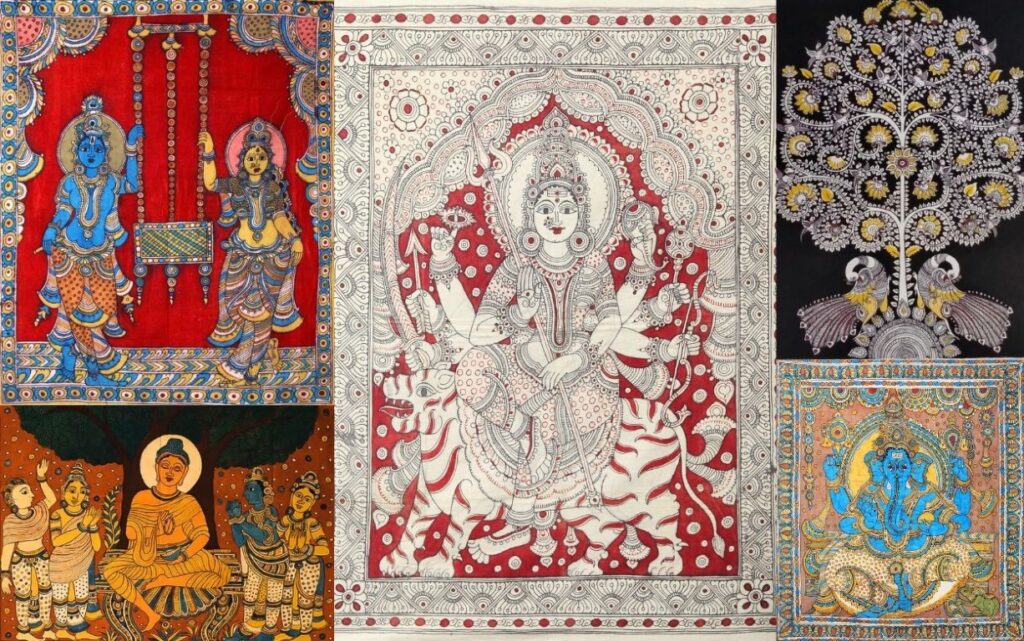
Depicts stories from epics and Puranas.
Visual FeaturesGods, goddesses, symbolic postures, ornate borders.
Cultural spaces · Traditional homes · CollectorsSymbolizes growth, balance, and cosmic harmony.
Visual FeaturesCentral tree motif, birds, animals, symmetrical composition.
Living rooms · Meditation spaces · Heritage interiorsFocuses on nature-inspired storytelling.
Visual FeaturesVines, flowers, animals, flowing patterns.
Eco-resorts · Cafés · Nature-themed interiorsNarratives divided into sequential panels.
Visual FeaturesFramed scenes, rhythmic repetition, decorative borders.
Wall panels · Corridors · ExhibitionsTraditional motifs with modern compositions.
Visual FeaturesSimplified figures, muted backgrounds, modern layouts.
Modern homes · Boutique spacesWHAT OUR CLIENTS SAY
The studio created a stunning custom Kalamkari artwork depicting a mythological scene for our living room — the natural dyes and intricate pen-work were extraordinary. It's now a conversation starter every time we have guests over.
We commissioned a custom Kalamkari wall hanging featuring a tree-of-life design as a wedding gift — the detailing and colour work were immaculate. The team was professional from the first briefing call to final delivery.
The studio designed a large-scale custom Kalamkari piece perfectly matched to our home's colour palette and decor — the calm precision they brought to every motif made the whole process effortless. It's the centrepiece our guests always ask about.
Kalamkari means "pen work," and the name undersells it slightly — a genuine piece can take days to complete, between the fine pen-drawn outline and the natural dyeing process that fixes colour permanently into cloth. That patience is exactly what a printed imitation can't fake. This page covers what makes the tradition distinct, the subjects and formats I paint on commission, exactly how the process runs, materials and pricing, and how to commission a piece across Delhi NCR.
Kalamkari is a hand-painted textile art tradition from Andhra Pradesh, created using a fine bamboo or date-palm pen to draw outlines that are then filled with natural dye. Two regional styles exist: Srikalahasti, known for detailed mythological scenes drawn entirely freehand, and Machilipatnam, which combines hand-drawing with block-printed outlines. The traditional dyeing process — mordanting, dyeing in stages, boiling and washing to fix colour permanently — can take several days for a single piece.
That slowness is the whole point. A commissioned piece using the genuine process carries colour that's chemically bonded into the fibre rather than sitting on top of it, which is part of why authentic Kalamkari textiles have survived for generations. A shortcut version using printed dye patterns fakes the look but not the permanence, and it shows over time as the colour behaves differently under wear and washing.
Kalamkari's mythological narratives and fine detail suit spaces that want depth and a story, not just decoration — a study, a formal living room, a space with cultural or spiritual significance to the person commissioning it. The natural dye palette also ages differently from synthetic colour, softening slightly over years in a way many people find more attractive than a piece that stays flat and unchanged.
It's also a genuinely rare commission to find done properly outside Andhra Pradesh. Most Kalamkari-style textiles sold in Delhi are printed imitations rather than hand-drawn and naturally dyed, so a real commissioned piece stands apart from what's commonly available.
The tradition covers a specific range of subjects and can be delivered on fabric or canvas, depending on your preference.
Detailed scenes from Indian epics and mythology are the tradition's most classic subject, drawn in the Srikalahasti style with dense, story-driven composition. These suit clients wanting a piece with genuine narrative depth rather than purely decorative appeal.
A lighter, more decorative direction — repeating floral and paisley patterns in the tradition's characteristic fine line and natural dye palette. These work well for a smaller, more subtle piece than a full narrative scene demands.
Traditional temple-hanging formats, historically used to depict deities and religious narratives in a vertical panel, translate well to a home space with spiritual or devotional significance.
For a genuinely large feature — a formal reception, a cultural centre, a large residential wall — Kalamkari's fine detail can be scaled up as a mural, though this needs careful planning since the pen technique is naturally suited to a more intimate scale.
Here's exactly how a commission runs, start to finish:
Kalamkari can be commissioned on treated cotton or silk fabric, closer to the traditional textile format, or adapted to canvas for a piece that hangs like conventional wall art. Here's how sizing tends to work:
| Format & size | Where it works | Good to know |
|---|---|---|
| Small fabric panel (12–20 in) | Desk, gallery wall, gifting | Closest to the traditional textile format |
| Medium fabric or canvas (24–36 in) | A study or formal living space | The most-commissioned range |
| Large panel or mural (40 in+) | A reception, cultural space, or feature wall | Needs careful planning given the technique's fine detail |
Fabric pieces are typically framed behind glass or mounted on a backing board to protect the natural dye surface; canvas pieces can be gallery-wrapped or float-framed like a conventional painting. Ready-to-hang fixings are included on all framed commissions.
This is the one place Kalamkari differs most from other commissions: if you choose the full traditional natural-dye process, timelines run longer than a typical painting commission, since mordanting, dyeing in stages, and fixing colour genuinely takes several days beyond the drawing itself. A canvas-based piece using colour rather than the full dye process moves faster, closer to a standard painting timeline.
What moves the price:
Once your brief is understood, you get a firm figure and an honest timeline before any work begins.
A genuine Kalamkari commission makes a meaningful gift for someone who'd appreciate craft with real depth behind it — a milestone gift, a piece for someone with a connection to South Indian culture or textile tradition, or a devotional piece for a family that values that significance.
As decor, it suits a considered, slightly formal space rather than a casual one. If you're drawn to a bolder, more graphic folk style instead, custom Gond art offers a very different visual language built from dense pattern rather than fine narrative line work.
Care depends on whether the piece uses natural dye on fabric or colour on canvas:
Commissions here are painted by a full-time team of practising artists working under the direct mentorship of folk-art fusion artist Rajni Dutta, from the studio in C.R. Park, South Delhi. Kalamkari is taught and commissioned alongside Madhubani, Gond, Lippan, and mandala, treated as its own tradition with its own technical demands, not folded into a generic "Indian folk art" offering.
Credibility matters when you're commissioning a craft this specific, so worth knowing: the studio has been covered by Hindustan Times, Business Standard, ThePrint, and ANI, and has delivered creative work for organisations including Airbnb, Qualcomm, upGrad, and Shoppers Stop. The story behind the studio and its founder fills in the rest.
If you'd rather learn the pen technique yourself than commission a piece, our Kalamkari art classes teach the same drawing method used in commissioned work, for anyone who wants to try the line work firsthand.
It's built from fine pen-drawn outlines filled with natural dye rather than brushwork or block printing alone, and the traditional dyeing process chemically fixes colour into fabric rather than sitting on the surface — a slower, more permanent method than most other folk mediums.
It can — a commission isn't bound by a single session's time limit, so the full traditional mordant-and-dye process is genuinely available if you want it, alongside a faster canvas-based option using colour rather than the full dye treatment.
Both. Traditional fabric panels closer to the textile format, and canvas-based pieces adapted to hang like conventional wall art, are both available, alongside mythological scenes, floral motifs, and temple-hanging formats.
It depends heavily on whether the full traditional dye process is used, plus size and subject complexity. Fabric pieces using the full process take longer than canvas-based work, since dyeing in stages genuinely takes several days. A firm quote and timeline follow once your brief is reviewed.
Fabric pieces should be framed behind glass and never washed directly. Avoid prolonged direct sunlight and keep away from damp walls. Canvas-based pieces need only light, regular dusting.