
Rajni Dutta is renowned for her devotion-driven artistry, intricate patterns, and exquisite detailing rooted in the sacred Pichwai tradition. Her works reflect spiritual richness, symbolic depth, and exceptional craftsmanship inspired by the life of Lord Krishna.
Rajni Dutta’s Pichwai artworks are ideal for temples, pooja rooms, luxury interiors, spiritual spaces, and collectors seeking timeless devotion-based art. Combining classical aesthetics with refined execution, each piece radiates serenity, reverence, and artistic grandeur.
HOW IT WORKS
A clear, four-step process from measurement to installation — designed to make commissioning a Pichwai simple and stress-free.
Share the dimensions of your space so we can calculate the area and provide accurate pricing before work begins.
Select your preferred style and surface. Permanent and temporary options are available.
Sharing references and space photographs helps visualise the design accurately before creation begins.
Once the design and scope are confirmed, we schedule the work and handle delivery or installation.
PRICING CALCULATOR
Enter your dimensions and select a surface to get an instant price estimate.
OUR SERVICES
Rajni Dutta offers devotional Pichwai art services inspired by Nathdwara’s sacred traditions, reflecting intricate detailing, symbolic richness, and spiritual serenity — serving temples, collectors, luxury homeowners, and spiritual institutions.
Pichwai art enhances devotion and sanctity.
Rajni creates devotional Pichwai artworks that elevate the sanctity and beauty of living spaces.
Rajni's Pichwai artworks are sought after by collectors, galleries, and cultural institutions.
Every Pichwai commission is approached with reverence, precision, and devotional intent.
Rajni shares the sacred techniques and iconographic traditions of Pichwai through guided learning sessions.



WHY CHOOSE US
Rajni Dutta is celebrated for her devotional sensitivity and intricate craftsmanship in Pichwai art, where spirituality, symbolism, and fine detailing converge into sacred acts of devotion.
Rajni approaches Pichwai art with reverence, understanding its devotional significance centered around Shrinathji and Krishna Leela.
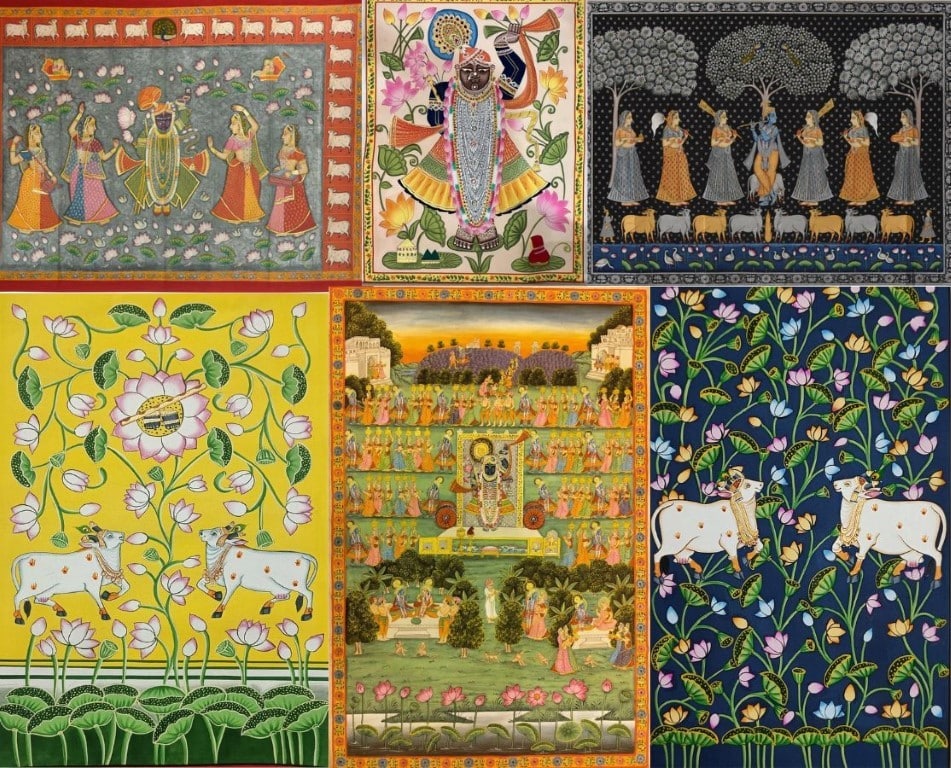
Her artworks feature elaborate floral motifs, cows, lotuses, peacocks, and symbolic elements rendered with precision.
Each piece radiates calm, symmetry, and spiritual depth—ideal for sacred and contemplative spaces.
Her Pichwai paintings are created as timeless pieces meant to be cherished across generations.
Seasonal festivals, specific Leelas, or personal devotional requests are thoughtfully incorporated.
Whether for homes, temples, or collectors, Rajni ensures visual sanctity and artistic excellence.
PICHWAI STYLES
From classical freehand to contemporary stencil work — every style carries its own cultural heritage and visual language.
Centers on the divine form of Shrinathji.
Visual FeaturesDark complexion, ornate attire, lotus motifs, cows.
Pooja rooms · Temples · Devotional spacesDepicts Krishna's divine dance with the Gopis.
Visual FeaturesCircular compositions, rhythmic figures, festive mood.
Spiritual interiors · Heritage homes · CollectorsSymbolizes purity, abundance, and devotion.
Visual FeaturesBlooming lotuses, sacred cows, lush detailing.
Meditation areas · Luxury interiorsRepresents different Utsavs and seasons.
Visual FeaturesAnnakut, Sharad Purnima, floral decorations, gold accents.
Temples · Festive décor · Exhibition displaysSimplified devotional compositions for modern tastes.
Visual FeaturesReduced detailing, balanced color palette, clean layouts.
Modern homes · Curated spiritual spacesWHAT OUR CLIENTS SAY
The studio created a stunning custom Pichwai painting depicting Shrinathji for our puja room — the layered detailing and devotional artistry were extraordinary. It's now a cherished piece our family treasures every day.
We commissioned a custom Pichwai piece featuring a lotus pond motif as a wedding gift — the intricacy and colour work were immaculate. The team was professional from the first briefing call to final delivery.
The studio designed a large-scale custom Pichwai artwork perfectly matched to our home's colour palette and decor — the calm precision they brought to every detail made the whole process effortless. It's the centrepiece our guests always ask about.



Pichwai paintings were built to hold a room's attention from across a temple, not to be admired from six inches away. That means a genuine commission has to work at scale — rich colour, dense layered detail, and enough visual weight to anchor a wall the way the original tradition anchored a shrine. This page covers what makes the tradition distinct, the subjects I paint on commission, exactly how the process runs, materials and pricing, and how to commission a piece across Delhi NCR.
Pichwai is a devotional painting tradition from Nathdwara, Rajasthan, historically created to hang behind the idol of Shrinathji, a form of Krishna, inside temples of the Pushtimarg sect. Paintings are rich and densely layered, most often depicting Krishna with cows, lotus ponds, and seasonal festival scenes, traditionally rendered in vivid natural pigment with fine gold detailing on more elaborate pieces.
The recurring cow motif is the tradition's real technical signature — cows appear constantly, tied to Krishna's identity as a cowherd, and rendering them with the right proportion and grace is one of the clearest signs of a properly trained hand. Scale and density matter too: a genuine Pichwai composition is meant to fill its surface with layered detail, not leave open space the way a more minimal piece would.
Pichwai's richness and scale make it a genuine anchor piece — it was built to command a room, and that quality translates directly to a home or office feature wall. It suits a space with spiritual or devotional significance, or simply a room that wants real visual weight and warmth.
It's also rare to find commissioned properly outside Rajasthan. Most Pichwai-style pieces sold elsewhere are printed or simplified, so a genuinely hand-painted commission with real layered detail stands apart from what's commonly available in Delhi.
The tradition centres on a specific set of devotional subjects, each suited to different spaces and purposes.
Direct depictions of Shrinathji in the traditional stylised form are the most iconic Pichwai subject, suited to a devotional space or anyone with a genuine connection to the tradition.
Compositions built around cows in a pastoral setting, often tied to festivals like Gopashtami, showcase the tradition's most recognisable and technically demanding motif. These suit a client drawn to the gentler, pastoral side of the tradition rather than a direct deity portrait.
Scenes depicting Krishna festivals — the moon-viewing celebrations of Sharad Purnima, or lotus-pond compositions rich with seasonal symbolism — let the tradition's layered, atmospheric side show off across a fuller composition.
Given the tradition's original function as a large temple backdrop, Pichwai scales up genuinely well as a mural or oversized panel for a reception, a devotional room, or a large feature wall.
Here's exactly how a commission runs, start to finish:
Pichwai can be commissioned on canvas or paper, with gold-leaf detailing available as an option for more elaborate pieces. Here's how sizing tends to work:
| Piece size | Where it works | Good to know |
|---|---|---|
| Small (12–18 in) | Desk, gallery wall, gifting | Quick to make, easy to ship |
| Medium (24–36 in) | A devotional space or living room | The most-commissioned range |
| Large (40 in+) | A feature wall or reception | True to the tradition's original scale as a temple backdrop |
| Mural (on-site) | Devotional rooms, large feature walls | Needs a site visit or detailed brief |
Canvas pieces can be gallery-wrapped or float-framed; paper-based pieces are typically framed behind glass to protect the surface, especially where gold detailing is involved. Ready-to-hang fixings are included on all framed commissions.
A small piece can be ready within one to two weeks. Larger, more layered compositions, and any piece including gold-leaf detailing, take considerably longer, since the fine motif work and gilding can't be rushed without the piece losing the precision the tradition depends on.
What moves the price:
Once your brief is understood, you get a firm figure before any work begins.
A Pichwai commission makes a genuinely meaningful gift for someone with a devotional connection to Krishna or Shrinathji, or for a housewarming where a rich, colourful anchor piece is exactly what a room needs. As decor, its density and scale mean one well-placed piece does the work of several smaller ones.
If you're drawn to a different devotional or narrative tradition instead, custom Pattachitra art offers a visually distinct alternative built from narrative scroll painting rather than a temple-backdrop composition.
Care is straightforward with a few precautions:
Commissions here are painted by a full-time team of practising artists working under the direct mentorship of folk-art fusion artist Rajni Dutta, from the studio in C.R. Park, South Delhi. Pichwai is taught and commissioned alongside Madhubani, Gond, Kalamkari, Pattachitra, and mandala, treated as its own tradition with its own motif discipline, not folded into a generic "devotional art" offering.
Credibility matters when you're commissioning something this specific, so worth knowing: the studio has been covered by Hindustan Times, Business Standard, ThePrint, and ANI, and has delivered creative work for organisations including Airbnb, Qualcomm, upGrad, and Shoppers Stop. The story behind the studio and its founder fills in the rest.
If you'd rather learn the technique yourself than commission a piece, our Pichwai art classes teach the same motif and layering method used in commissioned work, for anyone who wants to try painting these scenes by hand.
It was traditionally painted to hang behind the idol of Shrinathji in temples, so genuine compositions are dense, layered, and built to command attention at scale, rather than intimate or minimal. The recurring cow motif is also a distinct technical signature of the style.
Gold-leaf detailing is available as an option for more elaborate pieces, and can be discussed as part of your brief. Because a commission isn't bound by a single session's time limit, this level of detail is genuinely achievable.
Shrinathji and deity portraits, cow and pastoral scenes, lotus pond and seasonal festival compositions, and large temple-style panels or murals are all painted on commission.
It depends on size, whether gold-leaf detailing is included, and composition complexity. A small piece can be ready in one to two weeks; larger or gold-detailed work takes longer, since the fine motif work can't be rushed. A firm quote follows once your brief is reviewed.
Frame it behind glass, especially if it includes gold detailing, and avoid prolonged direct sunlight and damp walls. Canvas pieces are more tolerant but still benefit from being kept out of harsh light.