
You’ve probably seen it before you knew its name. A deer or a tiger built entirely from tiny dots and dashes. A tree whose branches turn into birds. Colours that hum. That’s Gond art, and if you’re here trying to figure out what you’re looking at, where it comes from, and why every inch of the surface is filled in, this is the page that answers it properly.
Not a textbook paragraph. The real story: a forest tribe, a teenager who changed everything in the 1980s, and a visual language where a line is never just a line.
What Is Gond Art?
Gond art is a tribal folk-painting tradition of the Gond community of central India, especially Madhya Pradesh. Built from fine dots, dashes and rhythmic lines, it depicts animals, trees, deities and folklore. Once painted on mud walls, it now lives on paper and canvas as celebrated contemporary Indian art.
The Gonds are one of the largest Indigenous communities in India, with a recorded history stretching back well over a thousand years. Beyond Madhya Pradesh, you’ll find Gond populations in Chhattisgarh, Maharashtra, Telangana and Odisha. The painting tradition we’re talking about comes largely from the Pardhan Gonds, a subgroup who served as the tribe’s bards and storytellers, carrying songs and myths from one generation to the next. Painting was simply the visual half of that same job.
The History of Gond Art: From Mud Walls to World Museums
For most of its existence, Gond art wasn’t hung on anything. It was painted directly onto the mud walls and floors of village homes, redone each season, meant to invite good fortune and mark festivals rather than to be sold. A well-made image was believed to bring good luck into the house. Because the walls weathered and washed away, the art was refreshed constantly, which made it a living practice rather than a fixed object.
Then came a turning point that anyone serious about Gond art history should know.
Jangarh Singh Shyam and the birth of “Jangarh Kalam”
In the early 1980s, the artist and Bharat Bhavan director Jagdish Swaminathan sent people into the villages of Madhya Pradesh looking for tribal talent. In Patangarh, they found a seventeen-year-old named Jangarh Singh Shyam painting the walls of his home. Swaminathan brought him to Bhopal and handed him something no Gond artist had used before: paper, canvas and modern paints.
Jangarh Singh Shyam (1962–2001) became the first Gond artist to move the tradition off the wall and onto portable surfaces. He exhibited in Paris and Tokyo, painted the interiors of Bhopal’s Bharat Bhavan, and effectively founded the entire contemporary school now called Jangarh Kalam. His life ended in 2001 while he was in Japan, but the movement he started didn’t. Nearly every well-known Gond artist working today traces their lineage, directly or by influence, back to him.
That’s why art historians will tell you that when we say “Gond art” in a gallery today, we often mean the Jangarh school specifically.
Meaning and Symbolism: Why Every Line Has a Job
Look closely at a Gond piece and you’ll notice there’s no empty space. Every form is packed with pattern, and that isn’t decoration for its own sake. The repetition carries meaning.
The Gond worldview treats nature as sacred and interconnected. Trees, rivers, animals, the sun and moon aren’t backdrop; they’re characters. A tree might represent life and shelter. A particular animal might belong to a clan’s origin story. The dense, rhythmic fill inside each shape is often described as breath or movement, a way of showing that the subject is alive rather than posed.
This is also why Gond art ignores Western perspective. There’s no vanishing point, no realistic shading. Composition flows intuitively, and everything sits on the surface with equal energy. Once you understand that the pattern is the meaning, the work reads completely differently.
Gond Painting Styles, Motifs & Signature Patterns
Gond painting balances two things at once: a shared visual vocabulary the whole tradition uses, and a personal signature that identifies the individual artist.
The motifs you’ll see again and again
The Tree of Life is the single most recognisable Gond motif, its branches teeming with birds and animals.
Animals and birds appear everywhere, from tigers and deer to peacocks, elephants, snakes and fish, usually stylised rather than realistic.
Deities and folklore show up as figures like Bada Dev and scenes drawn from Gond myth, the Gond Ramayana and local legend.
The natural world anchors it all: the Mahua tree, forests, rivers, and the sun and moon.
Signature fill-patterns (the artist’s fingerprint)
Here’s the detail most write-ups skip. Inside those forms, artists use a “fill” pattern that functions almost like a signature. One artist works in seed shapes, another in fish scales, another in comb-like lines. Common ones include sarson ke daane (mustard seeds), gehu ke baal (wheat spikes), fish scales, dots, dashes and crosshatching. Learn to spot the fill and you can often tell whose hand made the piece before you read the label.
How Gond Art Is Made: Materials and Technique
Traditionally, every colour came from the forest floor. Here’s how a classic piece came together:
1. Prepare the surface. Mud walls or floors were cleaned and smoothed as the base.
2. Gather natural pigments. Charcoal or coal gave black; ramraj soil near the Narmada gave yellow; chui soil or limestone gave white; geru dust gave red; cow dung and leaves gave green.
3. Make the brush. A tool called a koochi was made from beaten bark fibre.
4. Outline the story. The artist drew the main figures first, thinking in narrative rather than a single focal point.
5. Fill with pattern. Each form was filled with the artist’s chosen repeating motif, dot by dot, line by line.
Contemporary Gond painting keeps the drawing discipline but swaps the tools. Acrylics, poster colours, ink and fine-tipped pens on paper or canvas have largely replaced hand-ground pigments, giving brighter, longer-lasting colour. If you want the full studio walkthrough, our guide on how to make Gond art breaks the process down step by step.
Traditional Gond Art vs. Modern Gond Painting
Both are “real” Gond art. They differ in surface, tools and setting, not in soul.
| Aspect | Traditional Gond Art | Modern Gond Painting |
|---|---|---|
| Origin & purpose | Painted in tribal homes for ritual, festivals and good fortune | Made for homes, galleries and collectors |
| Surface | Mud walls and floors | Canvas, paper, wood panels |
| Colours | Natural earth pigments, limited palette | Acrylics and inks, wide palette |
| Themes | Folklore, deities, forest, animals | Same stories, reinterpreted for modern spaces |
| Line work | Strict rhythmic patterns passed down orally | More experimental, still rooted in tradition |
| Learned via | Oral tradition inside the community | Guided classes and workshops |
| Where it lives today | Heritage and cultural projects | Living rooms, studios, offices, hotels |
The best contemporary work refuses to treat this as a choice between heritage and relevance. It keeps the storytelling and the pattern discipline, then adjusts scale and palette for a modern room.
Famous Gond Artists You Should Know
Jangarh Singh Shyam is the pioneer, the first to paint Gond art on paper and canvas, founder of Jangarh Kalam, and the artist who carried the form into international galleries. Every list starts here.
Bhajju Shyam is arguably the most celebrated living Gond artist. His illustrated book The London Jungle Book won global recognition, and in 2018 he became the first Gond artist to receive the Padma Shri. His paintings were gifted to visiting world leaders during the 2022 Tokyo summit.
Ram Singh Urveti is known for richly detailed animals and mythological scenes, with international acclaim.
Venkat Raman Singh Shyam brings a socio-political voice to the tradition, including his well-known Mumbai Series.
Gond Art in Modern Homes — And How to Own or Learn It
Gond art works in a contemporary interior for a simple reason: it doesn’t fight the room. It anchors it. A single large canvas over a sofa, a framed piece in a reading corner, a mural in a café; the storytelling gives the space warmth without shouting.
If you’re buying, look past “does it match the cushions.” Informed collectors check for authentic pattern flow, a clear narrative rather than random shapes, balanced colour, and an artist who can explain the story behind the work. A commissioned piece takes this further, because you get to choose the story itself, a family memory, a forest, a personal symbol, rendered in true Gond visual language. You can explore custom Gond art commissions if you want a piece built around your own space and narrative.
And yes, you can learn it. Gond art can absolutely be picked up by a beginner, but not rushed. The line discipline and pattern rhythm take practice, and structured teaching helps you avoid the two classic beginner traps: over-decorating and losing the flow. If that’s the path calling you, join a Gond art class built to teach you how to think like a Gond artist, not just copy shapes.
Gond art has survived by adapting without forgetting itself. Learn its history, read its patterns, and it stops being a pretty painting and becomes something you can actually understand.
Frequently Asked Questions About Gond Art
What is Gond art?
Gond art is a tribal folk-painting tradition of the Gond community of central India, built from fine dots, dashes and rhythmic lines that depict animals, trees, deities and folklore. It began on mud walls and now appears on paper and canvas.
Where did Gond art originate?
It originates with the Gond tribe of central India, primarily Madhya Pradesh, with communities also in Chhattisgarh, Maharashtra, Telangana and Odisha. The contemporary painting form emerged from Patangarh village in the 1980s.
Who is the most famous Gond artist?
Jangarh Singh Shyam is the founding figure, the first to paint Gond art on paper and canvas. Among living artists, Bhajju Shyam is the most celebrated and was the first Gond artist to receive the Padma Shri.
What colours and materials are used in Gond painting?
Traditionally, natural pigments: charcoal for black, ramraj soil for yellow, chui soil or limestone for white, geru for red, and cow dung or leaves for green, applied with a bark-fibre brush. Modern artists mostly use acrylics and ink on canvas or paper.
Can beginners learn Gond art?
Yes. The motifs are approachable, but the pattern rhythm and line control take guided practice, which is why structured classes work far better than random tutorials.
What’s the difference between Gond art and Warli or Madhubani?
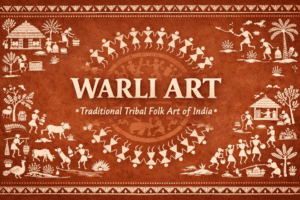
All three are Indian folk traditions, but Gond art uses dense, colourful dot-and-dash fills and nature themes from central India, while Warli is minimalist white geometry from Maharashtra and Madhubani is line-and-colour work from Bihar.